![Implied Impact of PNTR (trade exposure) on Deaths of Despair [from Pierce and Schott (2020)].](/assets/images/2026-04-16-societal-consequences-of-ai-induced-labour-demand-shocks/despair_usa.png)
Charles London, 16 Apr 2026
Or: why UBI might not save us.
This post was completed in a day as part of the OAISI writing sprint. I do not claim this to be a likely outcome of AI progress, but I think analysing the potential societal consequences of a mass unemployment event is important. There are people far more qualified than I to do this, and I hope to see much better pieces on this in the future!
Rapid AI progress could lead to significant employment shocks, as the marginal product of human cognitive labour in certain roles and professions declines rapidly. Production can remain high (and rise) as capital substitutes for labour, but there would be a decoupling of human employment, status, and income from production. The concern explored here is not technological unemployment per se, but the societal consequences of a persistent fall in the employment rate among previously economically central workers. In this post, I will analyse two previous economic shock events to attempt to understand these consequences.
My best guess at the mechanism of a potential AI shock looks something like: (1) a large labour-demand shock, leading to mass labour displacement, occurring in less than a decade; (2) new job creation significantly lags job losses; (3) leading to persistent non-employment and/or depressed wages. My hypothesis is that this would lead to significant societal spillover effects and reduction in quality of life. In our case studies we will approximate these effects by analysing changes in mental health and mortality (deaths of despair) statistics, changes in family formation, and political polarisation.
China shock and German reunification provide case studies for two different scenarios. In China shock, a market-driven adjustment led to incomes for a large proportion of the population being depressed for several years. In the German reunification, there were large transfers of wealth from the West to the East, propping up incomes and demand, but unemployment still led to a loss of purpose and legitimacy. These cases cover two plausible AI futures, one in which political and market response is slow, and distress is due to material economic losses, and another in which there is wealth redistribution (in the form of UBI or otherwise), where distress is due to perceived unfairness and loss of status.
China shock refers to the impact of rising Chinese exports on the manufacturing industry in the USA and Europe. The outcomes in the USA have been particularly well studied by David Autor, and I will focus on these.1
How well does China shock map onto my AI shock mechanism? (1) The labour demand shock was large and rapid, as “the fraction of US working-age population employed in manufacturing fell by a third” between 1990 and 2007 (Autor, Dorn, and Hanson 2013). (2) New job creation significantly lagged losses, particularly for incumbents, as “between 2000 and 2010, non-manufacturing employment rises […] offsetting approximately 60% of the manufacturing decline” and “the employment recovery stems almost entirely from young adults and foreign-born immigrants taking their first U.S. jobs in affected areas” (Autor et al. 2025). (3) The most trade-exposed counties experienced persistently higher unemployment and income depression. Autor, Dorn, and Hanson (2013) estimate that an interquartile shift in trade exposure (moving from a 25th percentile exposed county to 75th percentile) corresponded to a roughly 0.8 percentage-point decrease in the employment to population ratio, and to a fall in salary income of 2.14 percent.
This maps fairly well to my automation scenario, though the actual increase in unemployment and decrease in income are much less severe than some experts predict for AI (the IMF estimates 40% of jobs are exposed to AI (Cazzaniga 2024))2. A potential difference is that China shock was largely geographically localised, confined to regions in which manufacturing was a significant employer. However, Autor, Dorn, and Hanson (2025) note a “low responsiveness of population headcounts to trade exposure, because the alternative destinations […] are exposed to similarly negative labour demand shocks”. In the event of widespread, non-local AI automation, it is likely that similar migration patterns would be observed for the same reason. Taken together, China shock matches a scenario in which labour demand falls rapidly for some cohort, with persistent labour market scarring and income depression, even as output remains high.
The societal outcomes of even this relatively small change in employment were pronounced. In counties in which labour was most exposed to competition from foreign imports “deaths from despair” experienced a significant relative increase, largely driven by drug overdoses (see figure below). Pierce and Schott (2020) found that an interquartile shift in exposure was associated with a relative increase in deaths of despair of 2 to 3 per 100,000. This is significantly correlated with the unemployment rate in these regions, consistent with substantial declines in quality of life.
These counties experienced a significant shift towards GOP Republican candidates, at the expense of both moderate and more liberal candidates. Autor, Dorn, Hanson, and Majlesi (2020) found that “moderate politicians experience[d] the largest decline in election probability”, with more exposed trade districts having a 13.2 percentage point higher likelihood of electing a conservative Republican than less exposed districts. These candidates were often elected on the back of promises to “bring back jobs”, and tended to be more isolationist, plausibly linking this swing to declining economic conditions, and perceived unfairness and loss of status.
At the same time, fertility and marriage rates declined (Autor, Dorn, and Hanson 2019), due to loss of employment and earning of young men, raising the share of children living in below-poverty, single-parent households.
I believe China shock provides an important case study for a labour-demand shock, occurring without a significant reallocation of wealth or backstop of income. Even this relatively small drop in employment and labour income (smaller than many projected AI automation scenarios) led to a measurable deterioration in health outcomes, family formation, and political behaviour in exposed regions.
German reunification provides a contrasting case study. Rather than a market-driven adjustment with limited redistribution, reunification involved one of the largest peacetime fiscal transfers in modern history, as West Germany subsidised incomes, pensions, and public services in the East. This allows us to examine whether the societal consequences of large labour-demand shocks persist even when income losses are substantially offset.
The Treuhand was a government agency opened in 1990 responsible for the reprivatization of worker- and state-owned enterprise in East Germany. At reunification, “East German productivity was about one-third that of the West” (Dornbusch and Wolf 1994), leading the Treuhand to shutter many of these now (in the face of West German competition) unprofitable industries. This led to a significant and rapid increase in the unemployment rate, as “the employed share of the eastern working-age population […] declined from 83 percent in 1990 to 65.2 percent in 1999” (Burda and Hunt 2001). At the same time, a massive transfer of wealth from West to East was initiated, with over €1.2 trillion in support provided by 2004. These transfers amounted to around €80 billion a year, with “50% of them constitut[ing] social assistance, e.g. unemployment and retirement benefits” (Jansen 2004). These transfers “resulted in a quasi-equalization of net incomes and living conditions” (Enenkel and Rösel 2022), with “median disposable income in East Germany stabiliz[ing] at 85% of the West German average” (Bach, Bartels, and Neef 2021), backstopping consumption and living standards. Despite income stabilisation, unemployment persisted, with the rate remaining substantially higher in the East until 2005 and, while narrowing since then, remaining higher (see figure below); in 2018, the average unemployment rate of former East German states was 6.9%, compared to 4.8% in the West (Gramlich 2019).
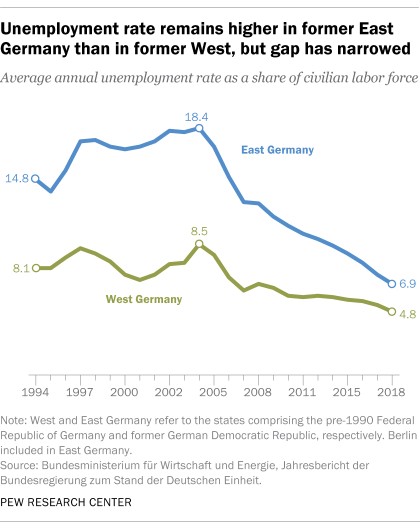
This corresponds to an automation scenario in which some form of wealth transfer (such as UBI) is initiated to prevent adverse economic conditions.
In the East, subjective life satisfaction dropped sharply post-1990. While it rebounded between 1991 and 1999, the post-unification peak in 1999 is still slightly below that of immediately pre-unification, in spite of “a marked increase in household income in East Germany despite rising unemployment” (Easterlin and Plagnol 2008). Convergence with the West has increased, but largely due to a decline in life satisfaction in West Germany, rather than improvements in the East. This is indicative that absolute material wealth is not the only factor in life satisfaction, and loss of economic purpose and perceived unfairness can contribute to declining subjective QoL even while material conditions improve.
Fertility statistics further reinforce this point. Between 1990 and 1991 the fertility rate in East Germany fell 40% (Witte and Wagner 1995). The birth rate did not recover to around pre-unification levels until 2010 (Statistisches Bundesamt (Destatis) 2025), as family formation was impacted despite backstopped income.
Similarly to China shock, we again see an increase in political polarization, with an increase in vote share for non-mainstream parties, and measurably higher alienation in the East. In the immediate aftermath of reunification, the vote share for the Party of Democratic Socialism (a left-wing populist party) increased from 11% to 20% as a response to privatization (Hager et al. 2025). Kellermann (2024) found that “East Germans who lost their jobs exhibit significantly lower trust levels, lower political interest and a lower identification with mainstream democratic parties, even up to 30 years after reunification”. Polarization is still apparent in the current political landscape, as the far-right Alternative for Germany (AfD) achieved the leading vote share in former East Germany with 29.7% of the vote, while being only fourth in the West (Wieder 2024). This suggests that even with an absolute improvement in material conditions, loss of purpose and status, along with perceived unfairness, can contribute to alienation with mainstream politics for years.
On a slightly more hopeful note, East Germany did not see an increase in deaths of despair post unification. In fact in “the former East Germany, mortality rates fell dramatically after German reunification” (Currie 2024). This suggests that the implementation of an economic safety net in the form of wealth transfers can prevent mortality crises.
Under the assumption that AI automation produces significant labour-demand shocks, we can expect to see broad societal consequences, including reduced subjective life satisfaction, reductions in family formation, and increased political polarisation. Wealth transfers may prevent worsening health outcomes and mitigate material hardship, but cannot replace the status, purpose, and legitimacy provided by unemployment, and are therefore unable to prevent persistent social and political disruption.
AI automation might be less severe if new tasks are created endogenously and quickly, or if AI complements human preferences (more demand for services, preference for humans in certain jobs).
It could also potentially be more severe: (a) white-collar workers generally have more political capital; (b) there may be a greater loss of perceived status from losing “elite” white collar jobs; (c) if AI substitutes for labour, new job creation could be significantly more impaired than in either case.
Autor, David H., David Dorn, and Gordon H. Hanson. 2013. “The China syndrome: Local labor market effects of import competition in the United States.” American Economic Review 103 (6): 2121-2168.
Autor, David, David Dorn, and Gordon Hanson. 2019. “When work disappears: Manufacturing decline and the falling marriage market value of young men.” American Economic Review: Insights 1 (2): 161-178.
Autor, David, David Dorn, Gordon Hanson, and Kaveh Majlesi. 2020. “Importing political polarization? The electoral consequences of rising trade exposure.” American Economic Review 110 (10): 3139-3183.
Autor, David H., David Dorn, Gordon H. Hanson, Maggie R. Jones, and Bradley Setzler. 2025. “Places versus people: The ins and outs of labor market adjustment to globalization.” RF Berlin-CReAM Discussion Paper Series.
Autor, David, David Dorn, and Gordon Hanson. 2025. “Trading places: Mobility responses of native-and foreign-born adults to the China trade shock.” ILR Review 78 (1): 10-36.
Bach, Stefan, Charlotte Bartels, and Theresa Neef. 2021. “When Capitalism Takes Over Socialism: (Missing) Capital and East-West-German Income Inequality.” International Association for Research in Income and Wealth (IARIW). https://iariw.org/wp-content/uploads/2021/07/Bach_Bartels_Neef_Paper.pdf
Burda, Michael C., and Jennifer Hunt. 2001. “From reunification to economic integration: Productivity and the labor market in Eastern Germany.” Brookings Papers on Economic Activity 2001 (2): 1-92.
Cazzaniga, Mauro. 2024. “Gen-AI.” Staff Discussion Notes 2024 (001). http://dx.doi.org/10.5089/9798400262548.006
Currie, Janet. 2024. “Health and inequality.” Oxford Open Economics 3 (Supplement 1): i549-i556.
Dornbusch, Rudiger, and Holger C. Wolf. 1994. “East German economic reconstruction.” In The Transition in Eastern Europe, Volume 1, Country Studies, 155-190.
Easterlin, Richard A., and Anke C. Plagnol. 2008. “Life satisfaction and economic conditions in East and West Germany pre-and post-unification.” Journal of Economic Behavior & Organization 68 (3-4): 433-444.
Enenkel, Kathrin, and Felix Rösel. 2022. German Reunification: Lessons from the German Approach to Closing Regional Economic Divides. https://economy2030.resolutionfoundation.org/wp-content/uploads/2022/12/German-reunification.pdf
Gramlich, John. 2019. “East Germany has narrowed economic gap with West Germany since fall of communism, but still lags.” Pew Research Center. https://www.pewresearch.org/short-reads/2019/11/06/east-germany-has-narrowed-economic-gap-with-west-germany-since-fall-of-communism-but-still-lags/
Hager, Anselm, Moritz Hennicke, Werner Krause, and Lukas Mergele. 2025. “Sold to the West: Mass Privatization and the Socialist Revival in East Germany.”
Jansen, Heinz. 2004. Transfers to Germany’s Eastern Länder: A Neccesart Price for Convergence Or a Permanent Drag?
Kellermann, Kim Leonie. 2024. “Trust we lost: The impact of the Treuhand experience on political alienation in East Germany.” Journal of Comparative Economics 52 (1): 54-75.
Pierce, Justin R., and Peter K. Schott. 2020. “Trade liberalization and mortality: Evidence from US counties.” American Economic Review: Insights 2 (1): 47-63.
Statistisches Bundesamt (Destatis). 2025. “Total fertility rate.” https://www.destatis.de/EN/Themes/Society-Environment/Population/Births/Tables/birth-rate.html
Wieder, Thomas. 2024. “European elections highlight Germany’s political divide between East and West.” Le Monde. https://www.lemonde.fr/en/international/article/2024/06/14/european-elections-highlight-germany-s-political-divide-between-east-and-west_6674764_4.html
Witte, James C., and Gert G. Wagner. 1995. “Declining fertility in East Germany after unification: A demographic response to socioeconomic change.” Population and Development Review, 387-397.
Wolf, Martin, and David Autor. 2025. “Transcript: Martin Wolf talks to David Autor — could AI be a bigger threat to US jobs than China?” Financial Times. https://www.ft.com/content/4e260abd-2528-4d34-8fa4-a21eabfd6db9
A cautionary note: Autor gave an interview to the Financial Times in April of last year (Wolf and Autor 2025), in which he cautioned against making the comparison between China shocks and AI labour disruption. His chief reason is that he believes that disruption from AI will occur more slowly than it did in China shock (disagreeing with my Assumption 1). I personally believe that recent AI progress suggests a faster takeoff than he assumes, making it a relevant case study. ↩
Note, this is not the same as fully automatable. ↩